
Rider–Waite
The Tower Tarot Card Meaning
Keywords
Lightning, crown knocked off, two falling, flames in the windows, rocks, false structure. The words name a sudden show of a crack that was already there. They do not name a taste for chaos or a personality that breaks things.
The picture
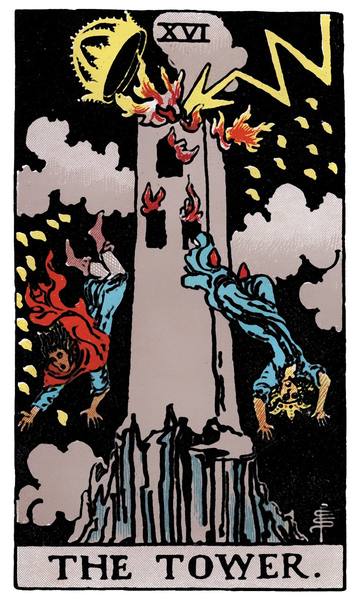
A stone tower stands on a black rocky crag. Lightning comes out of dark cloud and strikes the top. A gold crown, the crown of the building, is knocked off and falling clear of the roof. Flames push out of the windows. Two people are in the air, clothes bright against the dark, arms thrown out, not holding the stone. Sparks fall with them. The rocks at the base are bare. There is no ladder in the picture and no net. The bolt is the visible event. The window flames show the inside was already burning or ready to burn. Nothing in the scene suggests the tower was sound and then randomly hated by the weather. The strike shows the height. It does not invent the fault.
Upright
A structure comes down because it was false. Do not rebuild the same one.
This week you stop propping the cracked thing with a speech. If it has already fallen, list two columns before you rebuild anything. What was true: a skill, a kindness, a number that still holds. What was costume: a title, a story you all recited, a promise that required everyone to ignore one fact. Save the true column. Leave the costume on the rocks. Do not spend the day proving the old height can be restored by tonight.
The card does not promise the replacement arrives this week. It does not promise you were the honest one. It does not promise the other people will thank you for the mess. Shock is not a moral trophy. You may have helped build the false part. Say so if you did, in one sentence, and then keep your hands off the crown. A same-day replica usually repeats the lie with a new paint color. Give the ground a night. Then pick up only what you can carry without the story.
Reversed
The shock is smaller than it feels. Save what was true and leave the rest.
The miss is tape. You know the wall is wrong. The numbers do not meet. The relationship rule is a performance. The launch date depends on a claim nobody can support. Instead of letting the false piece go, you add another meeting, another loan, another reassurance. The lightning is delayed, not cancelled. The delay is expensive. People plan their weeks around a structure you already do not believe.
The other miss is a blast you set because you want the feeling of a clean dramatic end. A sound agreement, a working team, a repairable error: you blow it up and call the rubble honesty. Reversed Tower is not bravery. Check whether the structure is false or merely uncomfortable. Uncomfortable can be fixed with a fact and a new deadline. False means a load-bearing claim is a lie. If you cannot name the lie, do not reach for the bolt. If you can name it, stop buying tape.
Love
A relationship structure comes down because it needed a false piece to stand. The secret. The public story that you were exclusive while one of you was not. The plan to marry, move, or merge money that both of you recited and neither of you lived. The morning after is dangerous in a specific way. You will want the old sentences back because they are familiar and the ground is not.
Do not rebuild those sentences. If a true part remains, it is smaller than the story was. Name it without the crown: we still tell each other the truth about money, or we do not. We still want the same week, or we do not. The card is not an order to leave every shaken bond. It is an order not to pretend the height is intact. You are not promised reconciliation. You are not promised that pain means the bond was fake in every part. Sort the parts. Leave the costume.
Career
At work the shock is a false load-bearing claim giving way. The date that required a feature you do not have. The org chart that named owners who do not do the work. The client promise that depended on a number nobody sourced. When it goes, save the files that are still true. Save the people who can still do the job. Do not send the note that pretends the crack was a surprise to you if it was not.
A same-day rebuild usually copies the lie into a new deck. Cancel the performance of certainty first. Tell the smaller truth: what you can deliver, by when, with the staff you actually have. You will not be promised that honesty saves the account. You will be spared the second fall that comes from propping. If you are the one who struck the blow to look decisive, put that in the account too. Theater is not the same as a strike.
In a spread
In the first position, the break has already happened. Read the later cards as what to do with rubble, not as how to prevent a bolt that already landed. In the middle, you are in the falling. Do not narrate a moral yet. Find the true piece and the costume before you assign blame as a hobby. In the last position, the break is still ahead. Stop adding weight. Do not sign the extension, do not add the feature, do not announce the height.
Next to The Star, the fall is the prior fact and the next hour is a small pour, not a new tower. If you try to skip from lightning to a grand return, you miss the kneeling figure and go looking for another crown. Let the sparks finish falling. Then do one quiet repair. The pair is sequence. It is not a promise that ruin becomes glory if you suffer with the right face.
Is The Tower always a disaster?
A disaster is harm that arrives without a false structure under it, and that you cannot use. This picture is narrower. A building comes down because it was already untrue: a job that was a title without the work, a story that required everyone to ignore one fact, a plan propped on a number you hoped nobody would check. The fall can hurt. Hurt is not the same as total ruin. Sometimes the false part falling is the only way the true part can be seen at all. The misread runs in two directions. One is panic: you treat every setback, delay, or argument as this card and start smashing sound things. The other is romance: you hunt for a collapse so your life will feel important. Do not invite a bolt to avoid a plain conversation. Do not call a hard week a tower because you want the drama. Name the load-bearing claim. If it is false, let it go and keep what still stands on rock. If it is true, you are holding a different card and should fix the smaller problem instead of burning the floor.
Draw itMore tools
- Rising sign calculator
- Moon sign calculator
- Venus sign calculator
- Year lord — the house that rules this birthday year
- Progressed — where the progressed Moon sits now
- Transits — planets moving over your chart today
- Sky — the sky for this date, not a horoscope
- The day — one date, and what it touches
- Birth chart compatibility
- Zodiac compatibility
- Signs — the twelve signs, one page each
- Sun with rising — both signs, when you have a time
- Two moons — two Moon signs, and how they meet
- Cusp — the sign you were born on the edge of
- Tarot — one card, drawn for today
- Yes or no — a three-card tally, not a speech
- Love — a three-card draw about a bond
- Money — a three-card draw about work and cash
- Cross — ten cards, laid out once
- The deck — all seventy-eight cards, upright and reversed