
Rider–Waite
The Devil Tarot Card Meaning
Keywords
Deal, loose chain, horned figure, inverted pentagram, torch, pedestal, habit, terms. The words name a hold you can describe. They do not name a curse, a destiny, or a person who has no hand on the loop.
The picture
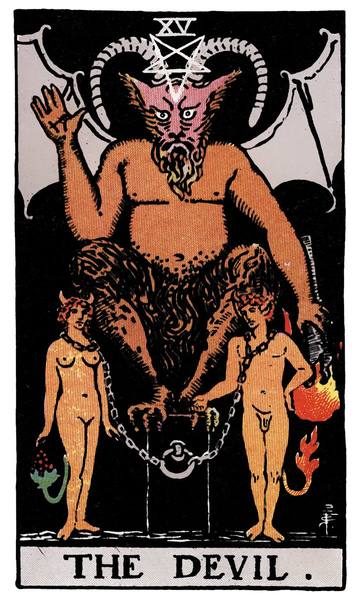
A horned figure stands on a black pedestal, goat-faced, bearded, with bat wings and taloned feet. An inverted pentagram sits on the forehead. One hand is raised. The other holds a torch pointed down, flame toward the pair below. A ring is fixed to the front of the block. Two naked people, a man and a woman, stand in front of the block with small horns of their own. Chains loop their necks and run to the ring. The loops are wide. Their hands are free. Nothing in the picture shows a lock that needs a key. Tails mark them as part of the scene they could step out of. The background is dark and bare. The torch lights the bargain. It does not light a way that has been sealed.
Upright
A deal, a habit, or a want that has a hold. Name the terms.
This week you write the deal in one sentence you could say out loud without poetry. What you give. What you get. What it costs on a dull Tuesday, not on the night you enjoy it. The extra hour you said you would not spend. The client who pays late and still gets your best morning. The person you text when you promised yourself you were done. The title you keep because the other options look plain. Put the cost beside the benefit. Then decide, on paper, whether the terms stay for the next seven days.
Seeing the chain is not the same as leaving. The card does not promise you will want to leave. It does not promise the other person is the villain, or that you are. It does not promise the want disappears when you name it. A lot of holds continue after they are described, and that continuation is a choice, not a spell. What the card refuses is the foggy version, the one where you suffer and still claim you cannot see the terms. If you will not say the cost, you have not looked at the picture.
Reversed
You can see the hold. That is the start of leaving it.
One miss is the announcement that you already left. You deleted the app, told a friend, bought the new notebook, and kept the spare key. You loosened one loop and tightened another: stopped the drink, doubled the scrolling; ended the flirt, started the unpaid overtime that gets you the same hit of being needed. The pedestal is still under your week. You have only changed the ornament.
The other miss is smashing a useful structure because you are bored and calling the boredom freedom. A contract with clear terms is not a devil. A practice that costs you and also pays you can be renegotiated without a bonfire. Reversed, the card asks which chain is actually loose and which story about captivity is more exciting than the edit. Name the habit you practice alone, even when the other person is not in the room. If the bond vanished tomorrow and the habit stayed, you have been blaming a witness.
Love
The situation is an attachment with terms nobody has said in a full sentence. Sex is the only language, and the rest of the week is a negotiation you pretend is not happening. Or money sits in one person's hands while both of you call it temporary. Or jealousy has a schedule: you check, they soothe, you check again, and the soothing is the product you are buying with the fight. None of this is a hex. It is a deal that flatters you somewhere.
Say the term without asking them to confess first. You can stay after you say it. Staying is allowed when both of you can hear the cost and still choose. Lying about the term, or calling it fate so you do not have to hear it, is the miss. The card does not promise they will loosen anything. It does not promise that love is absent. People remain inside real affection and bad terms at the same time. Affection is not proof the chain is tight. It is one of the things the chain is made of.
Career
At work the hold is often a yes you are proud of. The prestigious client who eats the week. The manager who praises you in public and moves the deadline in private. The role that pays well and requires you to repeat a claim you do not believe. Write what the arrangement costs in hours, in other work refused, in the sentence you have to say. Then decide if those terms stay through next month, not forever. Forever is how people avoid a dated decision.
A complaint in the hallway is not a decision. If you keep the deal, stop describing yourself as trapped when you are choosing the pay, the status, or the fear of a blank calendar. If you drop it, drop a specific piece this week: the unpaid extra, the false claim, the meeting that exists to flatter. You will not be promised a cleaner job appears on cue. You will only be asked to stop calling a chosen bargain a kidnapping.
In a spread
In the first position, the bind is the subject of the whole spread. Do not skip to the outcome cards until the terms are in a sentence. In the middle, you are negotiating with the loop and calling the negotiation a plan. Ask what you get from staying confused. In the last position, the result stays stuck until the terms are named. Insight at the end of the spread is late, but it is still the task. A hopeful last card does not unlock a deal you refuse to describe.
Next to The Tower, the structure falls if you keep calling a bad bargain a home. The lightning does not create the rot. It shows a house built out of terms you would not sign if they were on a page. If both cards are present, do not renovate. Read the terms, keep what is still true, and let the false part hit the ground. A slower chain is not a repair.
Does The Devil mean this bond is cursed?
A curse would mean the loop cannot come off. In the picture the chains are loose enough to lift, and the hands are not tied. The hold is a deal: a habit, a payment, a status, a fear of the empty evening, a pleasure you do not want to time. Calling it cursed lets you skip the sentence where you admit what you get. You may still choose to stay. That choice is ordinary. It is not magic, and it is not proof you are wicked. The inverted pentagram and the horns make people reach for a story about evil outsiders. Look at the two humans again. They wear small versions of the same marks. The scene is participatory. If a relationship feels impossible to leave, check the practical knots that are real and separate from the card: money, housing, children, safety. Those need plans, help, and time. They are not undone by declaring yourself spellbound, and they are not honored by pretending a loose habit is the same thing as a locked door.
Draw itMore tools
- Rising sign calculator
- Moon sign calculator
- Venus sign calculator
- Year lord — the house that rules this birthday year
- Progressed — where the progressed Moon sits now
- Transits — planets moving over your chart today
- Sky — the sky for this date, not a horoscope
- The day — one date, and what it touches
- Birth chart compatibility
- Zodiac compatibility
- Signs — the twelve signs, one page each
- Sun with rising — both signs, when you have a time
- Two moons — two Moon signs, and how they meet
- Cusp — the sign you were born on the edge of
- Tarot — one card, drawn for today
- Yes or no — a three-card tally, not a speech
- Love — a three-card draw about a bond
- Money — a three-card draw about work and cash
- Cross — ten cards, laid out once
- The deck — all seventy-eight cards, upright and reversed