
Rider–Waite
Justice Tarot Card Meaning
Keywords
Record, upright sword, level scales, crown, curtain, consequence, oath, account. These words point at a file and a result you can keep. They do not describe a calm personality or a private sense of being right.
The picture
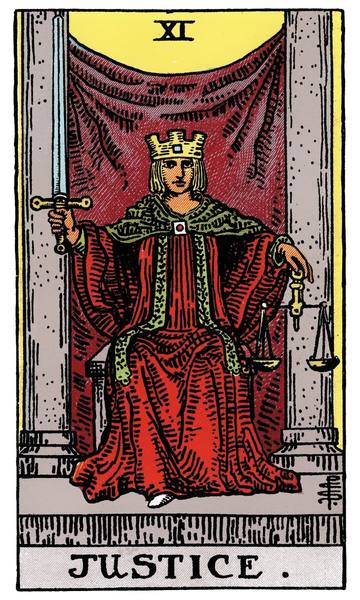
A crowned figure sits facing you on a stone seat between two grey pillars. A purple curtain hangs behind the shoulders, closing the gap between the pillars so the background stays private. The crown carries a square gold ornament at the front. A red robe shows under a green mantle. The right hand holds a double-edged sword straight up, hilt steady, point to the sky, not angled toward anyone in the room. The left hand holds a pair of gold scales, and the pans sit level, chains even. The face is bare of a smile. Yellow ground lies in front of the seat. Nothing in the picture is mid-swing. The sword is already up. The scales are already still. You are looking at a verdict that has been posed, not at a fight.
Upright
A fact has to be faced. Weigh it, then say the consequence.
This week you write the account before you argue. Put three lines on paper: what was promised, what was done, and what is still owed. Use dates, amounts, and names. If the shared bill is short, write the short number. If you said you would send the draft on Monday, write Monday and whether it went. If someone else left a task, write that too, in the same ink. Then choose one consequence you will actually carry out. A consequence is a change in the next action. Return the money. Correct the people who heard the wrong version. Decline the extra shift you already know you cannot do. Keep a copy of what you sent.
The card does not hand you a win, a judge, or a mood of fairness. It does not promise the other person will agree the pans are level. It does not promise that a clean explanation repairs the result. It does not turn a grudge into evidence. If you will not keep the consequence, you have not decided. You have only described a wish about how the story should sound.
Reversed
The scale is off. Check what you are leaving out of the account.
The miss is a scale with a finger on one pan. You tell a tidy story and leave out the part that costs you. You quote their lateness and skip your own. You call a result unfair because the consequence is inconvenient, not because the record is wrong. Sometimes the miss runs the other way: you pile every old fault onto today so the verdict feels large enough to match your anger. Either way the sword is being used as a pointer, not as a straight edge.
Look for the omitted line. It is often small. A text you did not answer. A number you rounded. A condition you added after they agreed. Put that line back before you announce anything. If the full account still supports your consequence, keep it and say it once. If the full account does not, drop the speech. A reversed Justice week is not a week for moral theater. It is a week for the missing entry.
Love
You and another person are treating fairness as a feeling one of you gets to declare. One of you is keeping a private tally. The other thinks the tally is a mood that should pass by morning. This week put the actual items where both of you can see them. Time. Money. The apology that was asked for and the apology that was given. The plan you both named and the plan you both lived. Do not add childhood history as a weight unless it changed a specific promise you are discussing now.
Nothing here guarantees they stay, agree, or become precise. You might learn that the bond runs on a score you do not want to keep. You might learn the score was mostly yours. Say one consequence and stop. A second speech is how people hide from the first. If you need them to feel ashamed before you will state the fact, you are not weighing. You are recruiting an audience.
Career
At work the card lands on a record that has to match a claim. A performance note. A contract line. A name missing from the list of who did the work. A deadline you reported as met. Open the file before the meeting. Check the version that was sent, not the version you remember writing. If your name is on a number, be able to show the number. If someone else did the piece you are about to describe as yours, say so in the first minute.
The card does not promise a promotion, a reversal, or a public apology from a manager. It does not reward the person who speaks longest. Bring one page. Ask one question that a document can answer. If the process is sloppy, say what is missing from the process, not that the whole place is unjust. A broad charge is easy to dismiss. A missing signature is not.
In a spread
In the first position, start from the record, not from the hope. Do not interpret the other cards until you can say what fact is already on the table. In the middle, the reading is the weighing itself. The cards beside it are weights, not decorations. Notice which fact you keep trying to skip while you talk. In the last position, a consequence is due before the week closes. Name it in a form you can do without anyone's permission, even if the larger outcome still depends on them.
Beside The Hanged Man, you do not get to skip the pause or use the pause to avoid the sword. Wait one beat. Read the account again. Then say the consequence anyway. The pause is for accuracy. It is not a pardon. If you only hang there, the scales stay unused. If you strike before you look, the sword is just a reflex.
Does Justice mean I am about to be in a court case?
A courtroom is not the card's automatic meaning. A courtroom is one place where an account meets a consequence. Most weeks the room is a kitchen, an inbox, a classroom, or a shared spreadsheet. The card can point at a lease clause, a grade, a bill, a promise about childcare, or a correction you owe in public. It can also point at a formal dispute, but only when that dispute is already a fact in your life. Do not read a lawsuit into a card because you want the stakes to look serious. Do not read innocence into it either. The picture does not say you win. The sword stays upright because the result has to be spoken straight, including when the straight version inconveniences you. If a real legal matter is already open, use a qualified person for the legal part and use the card only as a prompt to gather the record. The picture is not a summons and not a shield.
Draw itMore tools
- Rising sign calculator
- Moon sign calculator
- Venus sign calculator
- Year lord — the house that rules this birthday year
- Progressed — where the progressed Moon sits now
- Transits — planets moving over your chart today
- Sky — the sky for this date, not a horoscope
- The day — one date, and what it touches
- Birth chart compatibility
- Zodiac compatibility
- Signs — the twelve signs, one page each
- Sun with rising — both signs, when you have a time
- Two moons — two Moon signs, and how they meet
- Cusp — the sign you were born on the edge of
- Tarot — one card, drawn for today
- Yes or no — a three-card tally, not a speech
- Love — a three-card draw about a bond
- Money — a three-card draw about work and cash
- Cross — ten cards, laid out once
- The deck — all seventy-eight cards, upright and reversed