
Rider–Waite
The Chariot Tarot Card Meaning
Keywords
One direction, two sphinxes, armor, star canopy, city gate, a wand and no reins, a single front. Use the words to find the pull you will stop feeding. If you cannot name the one road, the card is describing a stall that only looks like motion.
The picture
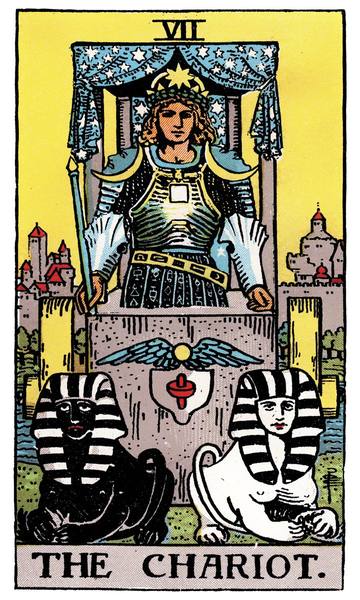
An armored figure stands in a chariot under a blue canopy hung with white stars. The curtains are drawn back. A laurel crown sits on the head, with a star above it. Crescent moons ride the shoulder plates. A square marks the chest. One hand holds a wand upright. The other rests on the hip, empty. There are no reins in either hand. The body is braced, not lounging. Below the breastplate a skirt is marked with small signs, and a belt carries more of them. The figure faces forward.
In front of the chariot sit two sphinxes, one black and one white. Both are seated. Neither is mid-stride. They do not share a color, and no strap runs from their bodies up into the driver's grip. On the face of the chariot a winged shape sits over a small shield. Behind the whole machine a walled city shows towers on both sides, with water at the base, under a flat yellow sky. The road out of the city is the point. The picture is one will in front of two unlike creatures. If the will drops, nothing in the harness will choose the road for him.
Upright
One direction. Split effort loses.
Pick the front you are actually driving, and park the other one until this week is done. A launch and a job search. Two products. Two versions of the story you tell at home. The black sphinx and the white one do not become a team because you want speed. They move when the aim is single. Write the aim in one line. Put the wand, meaning the attention, on that line. Take your hand off the second project even if it is good. Good and second is how this card gets wasted.
The empty hands matter. Control here is not a set of strings you yank when you panic. You do not get reins. You get a posture, a city you are leaving, and two animals that will not match if you shout different orders. So set the direction by what you do at the same hour each day, not by a speech in the morning and a contradiction at night. Armor is for staying in the seat when the week gets loud. It is not for picking fights so you can feel like a campaign.
The card does not promise a win. It does not promise that the city will applaud the exit, or that speed is the same thing as arrival. You can hold one direction all week and still be blocked by a fact you do not control. What you are promised, if the word even fits, is that split effort fails in a specific way. Both fronts move a little. Neither finishes. At the end you are tired and still between the gates. Choose the gate. Leave the other shut on purpose.
Reversed
The push is scattered. Stop one of the two fronts.
Reversed, the miss is a scattered push, or a statue in armor. In the first, you are in motion on two roads and you call the blur drive. You answer every message. You add a third goal because the first two have not given you a trophy yet. The sphinxes face different urges, and your hands keep grabbing for reins that are not there. Forcing the animals with a louder voice does not invent a harness. Stop one front today, in writing. Tell the person who expected it. A private intention to focus, while the calendar still shows both wars, is the reversal in a clean shirt.
In the second miss, the chariot has not moved. You bought the armor. You can describe the campaign. You sit under the star canopy and polish the wand. The city is still the whole view. Fear of choosing a road disguises itself as preparation. The sphinxes sit because you have not given them a single direction, not because the moment is unlucky. Name the road and move the wheels before noon on one chosen day. A short move counts. A better plan does not.
There is a harsh version of the first miss. You try to win by running people over. Deadlines used as weapons. A partner dragged along a plan they never heard. That is not the upright Chariot. The upright figure is stern and aimed. He is not a raid. If your week requires someone else to be afraid for you to feel effective, you have left the card. Put the aim on the work, not on their pulse.
Love
In love, one bond and one story. If you are pushing two stories at once, neither person can trust the pace, including you. The Chariot is not a license to chase. It is a requirement to stop splitting. End the maybe. Stop the secret thread. Or choose the single relationship and drive it at a pace you can say out loud. A double life can feel like skill. From either seat, it is a chariot with the sphinxes pointed apart.
If you are in one relationship, the two pulls may be inside it. Stay and tell the truth, or keep the peace and go numb. Move toward a shared plan, or keep a private exit so you never have to. Pick the pull you will feed this month. Tell them. A relationship cannot steer if each person is listening for a different city. Name the city. If you do not share one, say that, and stop decorating the mismatch with weekend plans.
The card does not promise that the person you aim at will want the same road. It does not promise that intensity will be read as care. Intensity with no single story is pressure. Care with a direction sounds like a plan. Where you will be on Friday. What you will stop doing. What you are asking them to stop doing. Leave the armor for the moments when old habits yank the wheel. Do not wear it to bed as a personality.
Career
At work, aim the effort at one front. A second campaign this week spends the win you have not banked yet. Finish the release, the case, the term, the hire, the repair. Let the attractive side project sit in a folder with a date when you may open it. If a boss keeps adding fronts, you still choose what you will do well and what you will flag as not done. Silence plus heroics is how you end up owning both sphinxes and a blame that belongs to the schedule.
Speed without a single aim is just motion. Measure the front in a result a stranger could check. Shipped, signed, paid, fixed, taught. Hours of urgency do not count. The canopy of stars is not a scoreboard. It is a cover over a driver who has to look at the road. Look up from the chat once a day and ask which animal you fed. If the answer is both, cut one before the day ends.
The card does not promise the market, the client, or the promotion. A clean aim can still meet a closed gate. What it does deny you is the excuse that you were doing everything, so the stall was not yours. You were doing two things halfway. That was a choice. Next week can have a different second front. This week has one.
In a spread
If the Chariot falls first, the push has started, or it is about to, and the rest of the spread should be read as the road and the risk, not as a reason to add luggage. If it falls in the middle, willpower is the subject. Ask which of the two pulls is in each neighboring card. If it falls last, the result depends on not opening a second war in the final stretch. A late distraction is the classic way a strong week undoes itself. Guard the last days as carefully as the first.
Beside Strength, do not confuse speed with nerve. The Chariot leaves the city. Strength stays with the lion and does not raise her voice. If you only charge, you break the thing you meant to carry. If you only endure, you never take the wheels out of the yard. When the cards sit together, set the direction first, then drop the volume and keep the grip soft enough to last. The sphinxes do not need a shout. They need one road and a driver who is still in the seat on Thursday.
Will I win if I draw the Chariot?
No. The card shows armor, a star canopy, a walled city, and two sphinxes that do not match. It does not show a trophy, a finish line, or a crowd. Winning is a result that depends on facts outside the picture. The picture only gives you the terms of the attempt. One direction. Both hands off any pretend set of reins. No second campaign sneaking in at night. People read the wand and the armor as a promise of victory. They are equipment for staying aimed. You can do all of that and still lose the bid, the race, the argument, or the month. If you lose while split, you learned little, because you never ran the actual test. If you lose while aimed, you know the road was blocked, and you can choose another single road next. That is the useful outcome. A guaranteed win was never on the card.
Draw itMore tools
- Rising sign calculator
- Moon sign calculator
- Venus sign calculator
- Year lord — the house that rules this birthday year
- Progressed — where the progressed Moon sits now
- Transits — planets moving over your chart today
- Sky — the sky for this date, not a horoscope
- The day — one date, and what it touches
- Birth chart compatibility
- Zodiac compatibility
- Signs — the twelve signs, one page each
- Sun with rising — both signs, when you have a time
- Two moons — two Moon signs, and how they meet
- Cusp — the sign you were born on the edge of
- Tarot — one card, drawn for today
- Yes or no — a three-card tally, not a speech
- Love — a three-card draw about a bond
- Money — a three-card draw about work and cash
- Cross — ten cards, laid out once
- The deck — all seventy-eight cards, upright and reversed