
Rider–Waite
The Star Tarot Card Meaning
Keywords
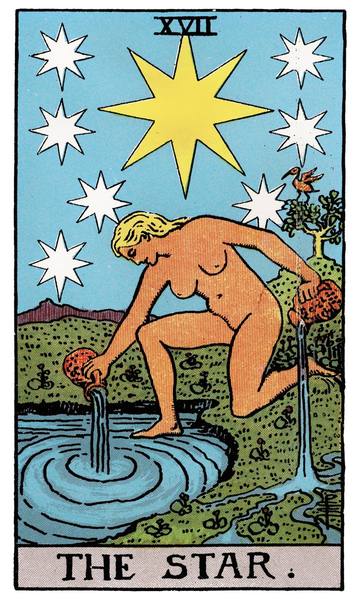
Pour, two jugs, pool, land, one large star, seven small stars, kneeling figure, bird in a tree. The words name a quiet repair after a break. They do not name a wish being granted or a personality made of hope.
The picture
A nude figure kneels at the edge of a pool under a night sky. One knee is on the land. One foot meets the water. The figure holds two jugs. One jug pours into the pool. The other pours onto the ground, the water splitting into streams that soak the bank. Above, one large eight-pointed star dominates, and seven smaller stars sit around it. There is no crowd and no banner. In the distance a tree stands on a rise, and a bird perches in it. Low hills close the horizon. The body is unhidden and unhurried. The work is the pour. The stars light the work. They do not hand the figure a prize, a robe, or an audience.
Upright
After the break, a quiet repair. Keep it small and keep going.
This week you do the small repair where nobody is clapping. Water the one patch. Answer one message without a speech attached. Fix the paragraph you have been stepping around. Walk the same short route and come back. Put ten honest minutes on the page that actually belongs to the work, not on a plan about the work. Keep the action smaller than your hope. If it needs an audience, it has left the picture.
The card does not promise recovery on a schedule. It does not promise the old life returns in its old size. It does not promise you will feel hopeful while you pour. Hope can be absent and the jug can still tilt. You are not owed a sign in return for the smallness. The large star is a light to see by, not a clerk taking orders. Do the pour again tomorrow at the same size. Repetition is the whole instruction. A comeback announcement is how this card gets counterfeited.
Reversed
Hope is thin today. Do the repair anyway, at a smaller size.
The miss is performed recovery. You tell people you are back. You buy the supplies for a life you have not lived on a single ordinary afternoon. You plan the reunion, the relaunch, the trip that will prove the bad year is over. Meanwhile the pool in front of you gets nothing, and the ground beside you stays dry. The picture has two jugs for a reason. One stream goes back to the source. One stream goes to the land you stand on. All of it poured into an audience is a third jug the card does not contain.
The other miss is refusing the small pour because it looks insulting next to the loss. You want a repair as large as the break, and since you cannot have that today, you do nothing. Dry pride feels like standards. It is a stall. Tip the jug at the size you can lift. If you are pouring everything into one person and calling it healing, stop and give the land a share: sleep, food, the task with your name on it. A person is not a pool you get to empty yourself into.
Love
After a break, a fight, or a long cold stretch, the useful move is ordinary and repeatable. A walk with a start time. A clear text that asks one thing. A meal without a verdict hiding in the dessert. You do not open with a speech about what the bond means in the grand scheme. You open with a presence they can recognize as you on a weekday.
A grand reunion asks them to clap. Many people will not, and they are not cruel for that. The card does not say they come back. It does not say you should wait in the kneeling pose until they notice. If they are gone, the pour is still for the ground you live on. If they are here, do not make them the only jug. One ordinary kindness, done again, is the repair. A promise about the next five years, offered before you can do this Thursday, is costume.
Career
Keep the work at a size you can finish while tired. One page. One bug. One honest hour on the thing you keep renaming as a comeback. Do not title the document as a relaunch. Do not book the announcement. The bird in the tree is not a press gallery. It is simply there while the water hits the ground.
You are not promised that the small hour compounds into the old status. It might. It might not. The card's instruction survives either result. If you skip the hour and polish the story of your return, you are working on the audience, not the land. Show one finished fragment to the person who actually needs it. Then stop. More fragments can come tomorrow. A tower built out of hope, in the week after a fall, is how you get lightning twice.
In a spread
In the first position, you are still in the aftermath. Do not pitch. Do not ask the later cards for a trophy. In the middle, the repair is the subject, and it is small on purpose. If you are bored by that, notice the boredom. It is the part of you that wants a parade. In the last position, the result is a slow mend, not a triumph. Read any brighter card nearby as light to work by, not as a scoreboard.
Next to The Moon, you are in danger of leaving the pour to decide your future in the dark. A dream, a hunch, a worried story about what the stars 'mean' for your fate: set it down and tip the jug. The stars in this picture are counted and visible. They are not a riddle you solve instead of working. If The Tower sits near as well, the order is fall, then pour. Do not reverse it.
Will The Star make my wish come true?
The card is not a grant, a lucky ticket, or a bargain with the sky. The large star lights a person who is already pouring. It does not take dictation. A wish that needs the week to rearrange other people around you is outside the picture. The figure is alone. Nobody is arriving with the missing object, the missing apology, or the missing job. If your wish is simply that you do one small true thing and do not announce a comeback, then you can act with the card instead of waiting for it to act on you. If your wish is a specific outcome from someone else's will, the card does not sign it. Wishing is allowed. It is not the instruction. The instruction is the two streams: return something to the source you drew from, and put something on the actual ground. Count that as the week. Leave the rest of the wish unbilled.
Draw itMore tools
- Rising sign calculator
- Moon sign calculator
- Venus sign calculator
- Year lord — the house that rules this birthday year
- Progressed — where the progressed Moon sits now
- Transits — planets moving over your chart today
- Sky — the sky for this date, not a horoscope
- The day — one date, and what it touches
- Birth chart compatibility
- Zodiac compatibility
- Signs — the twelve signs, one page each
- Sun with rising — both signs, when you have a time
- Two moons — two Moon signs, and how they meet
- Cusp — the sign you were born on the edge of
- Tarot — one card, drawn for today
- Yes or no — a three-card tally, not a speech
- Love — a three-card draw about a bond
- Money — a three-card draw about work and cash
- Cross — ten cards, laid out once
- The deck — all seventy-eight cards, upright and reversed