
Rider–Waite
The High Priestess Tarot Card Meaning
Keywords
Scroll, veil, pillars, moon, unsaid fact, private knowledge, one clear sentence. Use the words to locate what you already know and have not written down. They are not a command to become mysterious. If the knowledge cannot be put in a sentence, you do not have it yet.
The picture
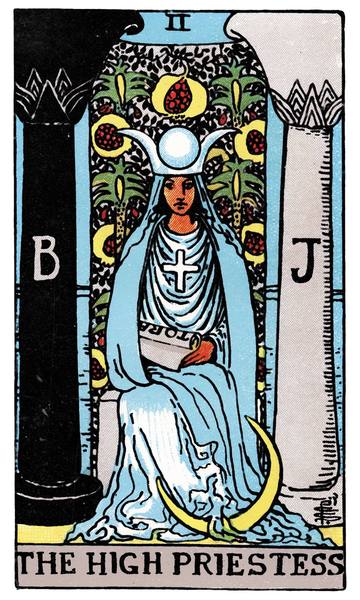
She sits between two pillars, one black and one white. The black pillar is marked with a B. The white pillar is marked with a J. She is still. Her robe is blue, and a cross lies on her chest. A horned crown holds a moon disk above her face. In her lap rests a scroll, partly covered by the robe, the letters TORA visible on what shows. She does not offer the scroll. She does not read it aloud. The book is closed enough that a passerby gets only a fragment.
Behind her hangs a veil patterned with pomegranates and palms. You do not see the water or the garden that may lie past the cloth. At her feet a crescent moon rests. The floor is stone. Nothing in the picture is mid-gesture. No one is arriving with news. The contrast of the pillars is the whole argument of the design. Two extremes stand, and she sits in the middle with the writing in her lap. The cross is small, geometric, and plain against the blue. The veil is the border between what can be shown and what is not ready to be shown.
Upright
What you know and have not said. Wait until it is clear, then say it once.
This week, write the thing you know before you spend it in a meeting or a fight. One sentence. Not a mood, not a hint, not a dream you had on Wednesday. The sentence might be a fact about money, a feeling you have been calling confusion, or a decision you already made and have not admitted. Put it on paper where you can see it without an audience. The High Priestess is a closed book, not a speech. The upright use of the card is to stop pretending you are empty while the scroll is in your lap.
Wait until the sentence is clean, then say it once to the person who needs it. A hint is not a talk. A sigh is not a talk. If you are not ready to say it, do not decorate the silence with meaningful looks and hope they will decode you. Decoding is how both of you get to pretend a conversation happened. Clarity first, in private. Speech second, in one piece. If the sentence is still a fog, the card is telling you to stay with the page, not to force a public decision tonight.
What the card does not promise is that silence is wisdom. It does not promise that your hunch is accurate just because it is quiet. It does not promise a revelation if you refuse ordinary evidence. Check the fact that can be checked. Then trust the sentence that survives the check. The moon at her feet is a light, not a fog machine. Use it to read the scroll. Do not use it as a reason to skip the words.
Reversed
A secret is running the day. Name it to yourself before you act.
Reversed, the miss is a secret that has started to run the day. You know the number, the betrayal, the desire, the fear, and you are making plans around it without putting it in language. People feel the weather and cannot see the cause. You call that privacy. Past a certain point it is avoidance with a veil over it. The scroll covered by the robe is fine while you are still reading. It is a problem when your choices are already public and the reason is still hidden, including from you.
The other miss is the opposite costume. You talk constantly about intuition, signs, and knowing, and you never write the sentence. Noise fills the place where the scroll should be. You ask three friends, then a fourth, so you will not have to stand next to your own line. The pillars get used as a debate stage. Black says one thing, white says another, and you never sit down. Reversal here is not a command to become loud. It is a command to stop the leak or stop the performance, whichever one you are doing.
This week, name the secret to yourself in words a stranger could understand. If it involves another person who will be affected, set a time to say the relevant part. Not the entire inner life. The part that changes the plan. If you discover you do not actually know, and you have been protecting a guess, drop the guess. A guess dressed as inner knowledge is how this card gets a bad reputation. The veil is for what is not ready. It is not for what you refuse to test.
Love
In love you know something you have not said. It may be that you want a clearer bond. It may be that you want less of one. It may be that you noticed a pattern and you have been hoping they will mention it first so you do not have to be the person who breaks the pleasant surface. This week, get the knowledge into one sentence before you bring it to them. If you cannot say it alone in a quiet room, you are not ready to say it at dinner, and a hint will only start a fight about your tone.
The card does not promise that they already know. People are not required to read a veiled face. It also does not promise that speaking will be received with grace. Say it once, without a stack of old cases unless the sentence truly needs one example. Then let them respond. If you speak and then take it back in the same hour, you have used the truth as a test, not as speech. If you stay silent past the point where the silence is changing the bond, the veil has become a wall.
A private fact that is only yours, and that does not change how you treat them, can stay private. Not every thought belongs in the kitchen. The test is practical. Are you making decisions they cannot see? Are you withdrawing, staying, spending, or hoping on the basis of a line you will not share? If yes, the line has to cross the veil. If no, stop interrogating yourself for a confession the relationship does not need.
Career
At work the useful fact is still private. You see a flaw in the plan, a risk in the date, a reason the client will stall, a skill the team is pretending it has. Write it down before you spend it in a meeting. A blurt in front of a crowd, before you know what you are actually claiming, turns the scroll into gossip. A note you never send turns it into resentment. The upright path is a written observation, then one conversation with the person who can use it.
Do not dress a guess up as research. If you have a feeling and no detail, go get one detail before you build a case. The High Priestess is not a license to undermine a project from the hallway. She is a license to refuse the hallway version until the sentence is accurate. If the fact is politically awkward, accuracy matters more, not less. Say what you saw, what it affects, and what you recommend. Leave the aura of special knowledge out of it. Special knowledge that cannot be checked is how trust dies on a team.
The card does not promise you will be thanked. It promises that a clear private fact is more useful than a public performance of concern. If you are the person hiding the fact from yourself, because admitting it would force a choice about the job, that is the scroll. Read it this week. You do not have to act on every line the same day. You do have to stop making schedules that ignore it.
In a spread
If she falls first, you already have more information than the rest of the spread is likely to add. Do not shuffle again in search of a louder card. Read what follows as commentary on a knowledge you are avoiding. If she falls in the middle, the answer is present and not yet spoken. The cards around her are noise until you write the sentence. If she falls last, do not force a public decision tonight. Sleep on the written line. Morning is for saying it or for filing it, not for a new search.
Beside the Empress, the order matters. The High Priestess is the knowledge. The Empress is the thing you make once you know. If you try to grow a result, a meal, a draft, a care, a room, while refusing the sentence, the growth will be aimed wrong. Read the scroll first. Then make one tangible thing that matches it. If you only contemplate, nothing grows. If you only produce, you may be feeding a plan the scroll already contradicted. The veil comes off for you before it comes off for the room.
Must I stay silent because I drew the High Priestess?
No. The card shows a closed scroll, not a sealed mouth. Silence is the stage before the sentence is clear. It is not a lifestyle, and it is not a moral duty to keep other people in the dark. Once the line is clean, and once another person is living inside the consequences, you say it. You say it once, in words they can answer. The common misread treats the veil as a permanent instruction. Stay mysterious. Drop hints. Let them work it out. That reading flatters the person who is afraid of a direct sentence. The pillars are still there after you speak. You do not lose the card by using ordinary language. You lose it by either blurting a half-formed guess or by withholding a finished fact past the point of fairness. Write first. Then speak. The moon is for reading by, not for hiding in.
Draw itMore tools
- Rising sign calculator
- Moon sign calculator
- Venus sign calculator
- Year lord — the house that rules this birthday year
- Progressed — where the progressed Moon sits now
- Transits — planets moving over your chart today
- Sky — the sky for this date, not a horoscope
- The day — one date, and what it touches
- Birth chart compatibility
- Zodiac compatibility
- Signs — the twelve signs, one page each
- Sun with rising — both signs, when you have a time
- Two moons — two Moon signs, and how they meet
- Cusp — the sign you were born on the edge of
- Tarot — one card, drawn for today
- Yes or no — a three-card tally, not a speech
- Love — a three-card draw about a bond
- Money — a three-card draw about work and cash
- Cross — ten cards, laid out once
- The deck — all seventy-eight cards, upright and reversed