
Rider–Waite
Wheel of Fortune Tarot Card Meaning
Keywords
Turn, wheel, sphinx, snake, jackal, letters, four creatures, an opening you did not book. Use the words to name what changed without your permission. They are not a promise of luck, and they are not a sentence. A turn is a fact. Your next move is still yours.
The picture
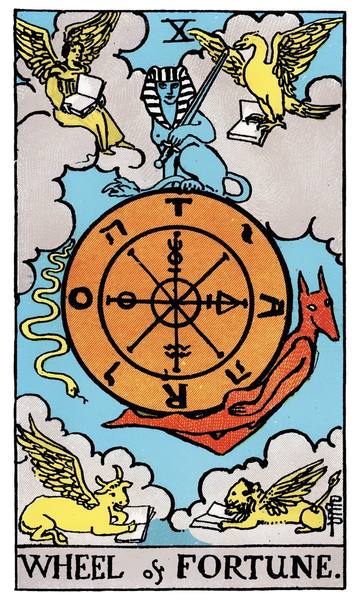
A great orange wheel hangs in a blue sky, clouds packed around it. On the rim the letters T, A, R, and O sit at the quarters, and Hebrew letters take their places among the bands, with the older marks of the metals set inside the circle. A sword-bearing sphinx sits on the top of the wheel, blue, calm, a striped headdress on the human face, as if stationed rather than surprised. At the left a yellow snake descends along the rim. At the right a red jackal-headed figure climbs. One goes down as the other goes up. Neither is the sphinx.
In the four corners, on clouds, are the living creatures. An angel with a book. An eagle with a book. A winged bull with a book. A winged lion with a book. Each one reads. None of them turns the wheel. The books are open, which makes the turn something that can be studied, not only suffered. The sphinx's sword is upright, not swung at the animals on the rim. The whole design says movement with witnesses. The wheel is larger than any rider. Nobody in the picture has a hand on a crank.
Upright
A turn you did not schedule. Take the opening it gives.
Notice the turn you did not schedule, and use the opening it gives. A role appeared because someone left. A plan failed and a different hour is now free. A person wrote after a long silence. A price, a policy, a season, a body changed. The Wheel is not your mood swinging. It is an outside movement that reorders the week. Name it in one concrete sentence before you build a story about what you deserve. Then ask what the new position makes possible in the next seven days. Take that piece. Do not spend the week trying to rebuild last month's shape out of panic.
You are not the hand on the crank. The snake descends and the jackal rises whether you feel ready. What is yours is how you meet the position you are actually in. If you are up, do not treat the height as a personality. The sphinx sits the top with a sword held still, not with a parade. If you are down, do not treat the drop as a verdict on your whole character. Read the book in your corner. What is the fact. What is the next honest adjustment. The creatures in the clouds keep reading while the wheel moves. Copy that. Panic is optional. Attention is not.
The card does not promise that the turn is good, or that a good turn will last. It does not promise a prize, a reunion, or a rescue timed to your hope. Fortune here is a change of position, not a moral report. You can meet a lucky opening badly and waste it. You can meet a hard turn cleanly and come out with a smaller, truer plan. Either result is a better reading of the card than the wish that the wheel will stop because you have had enough.
Reversed
A turn you are fighting. You can refuse the panic and still accept the change.
Reversed, the miss is fighting the turn, or refusing the choices you still have. In the first, you clutch last quarter's schedule, last quarter's status, last quarter's version of the relationship, and you call the clutch loyalty. The wheel has already moved. Your hands are tired. You rebuild the old meeting, the old budget, the old argument, and you are angry that it will not sit where it sat. Stop the rebuild for one day. List what is actually different. Act from that list once. Resistance can be brave when a change is unjust and you have a lever. It is waste when the change is a fact and your only tool is protest.
In the second miss, you go limp. Everything is the wheel, so nothing is your job. You wait to be spun into a better mood, a better offer, a better version of yourself. The books in the corners are open and you will not read yours. Passivity is not humility. It is a way to avoid the next small choice, which is still available. You cannot always change the turn. You can change whether you answer the letter, take the hour, tell the truth, or spend the money you do not have in order to feel the old life for one more weekend.
A third miss inflates a small wobble into doom, or a small piece of luck into a destiny. One delayed reply becomes a ruined year. One good interview becomes a plan you finance with money you need for rent. The wheel in the picture is large, and not every event is the wheel. Check the scale. If the change does not alter what you can do this month, do not reorganize your identity around it. If it does alter that, deal with the alteration and skip the omen language.
Love
In love, a turn arrived that you did not book. Someone's job moved. A truth came out. Desire changed shape. A chance to reconcile showed up, or a chance to leave got suddenly practical. Do not treat a change of weather as a verdict on the person's worth, or on yours. Ask what the turn opened, and what it closed. Then make one choice that matches the new ground. A panic ending and a panic merger are both ways of refusing to stand on the moving rim long enough to see.
If the turn is welcome, take the opening in a size you can sustain. A visit. A clearer agreement. A reunion that starts with ordinary days, not with a rewritten history. If the turn is unwelcome, grieve the position you lost and stop negotiating with the month as it was. The sphinx does not argue with the wheel. It stays seated and keeps the sword still. You can be steady without pretending you are glad.
The card does not promise that fate brought you the right person, or that a rough patch means the bond was false. Some turns test a sound relationship. Some expose a hollow one. You still have to look. Use the books. What did they do. What did you do. What is now possible that was not possible in May. Answer from those lines. A wheel is a poor excuse for avoiding a sentence you already know you owe them.
Career
At work the turn is not your plan, and it does not care. A reorg, a lost client, a sudden budget, a tool that makes a task obsolete, a door that opened because a senior person quit. Use what it opened. Rebuilding the old schedule out of panic wastes the only advantage a turn ever gives, which is a gap where a new placement can occur. Volunteer for the piece that now exists. Close the piece that the turn made pointless. Update the people who still think the old chart is real.
If you are on the way up, write down what you will not neglect. The sphinx holds a sword at the top for a reason. Height without attention becomes the next descent, and it takes other people with it. If you are on the way down, do the practical things before you do the identity crisis. The money, the portfolio, the conversation with the person who can hire you next. The jackal climbs. The snake goes down. Both are on the same wheel. Your craft is what you can carry to the next position. Protect that, not the title that just moved.
The card does not promise a comeback on your preferred date. It says a change is already in motion, and a week spent arguing with it is a week you do not spend reading your corner of the picture. Make one adjustment a colleague could see. Then another. Fortune favors the person who notices. That is as superstitious as this reading is willing to get. Noticing is a behavior.
In a spread
If the Wheel falls first, the turn is the premise. Do not read the later cards as a way to undo it. Read them as how to meet it. If it falls in the middle, the situation is already turning, and the cards on either side are the rising side and the falling side. Figure out which role you are in before you pick a strategy. If it falls last, the result is not fully in your hands. You can still act. You cannot honestly promise yourself a controlled ending. Leave room in the plan for a move you did not choose.
Beside Justice, which sits next to this card in the deck, keep both lessons. The wheel turns without asking your permission. The scales still ask what you did with the position you were given. A turn is not an alibi. If you were careless on the way up, the account remains. If you were careful on the way down, the account should say that too. When you read these neighbors together, accept the motion, then write the consequence you are willing to own. You do not steer the rim. You do answer for your hands.
Can I change the turn of the Wheel of Fortune?
Not always, and not in the way people hope. The picture has no crank. A sphinx sits the top, a snake descends, a jackal climbs, and four creatures read books in the corners. The wheel is larger than any of them. Some turns are already in motion by the time you draw the card. A resignation somewhere else. A market. An illness. A season. You do not think those back into last month. What you can change is your response, your preparation, and the next choice the new position makes available. You can stop wasting the opening. You can stop financing the old shape. You can tell the truth sooner. You can refuse a panic decision that would add a second turn you did choose. The misread is either total control or total helplessness. Both ignore the books. Read the change. Do the part that is still a decision. Leave the rim to the rim.
Draw itMore tools
- Rising sign calculator
- Moon sign calculator
- Venus sign calculator
- Year lord — the house that rules this birthday year
- Progressed — where the progressed Moon sits now
- Transits — planets moving over your chart today
- Sky — the sky for this date, not a horoscope
- The day — one date, and what it touches
- Birth chart compatibility
- Zodiac compatibility
- Signs — the twelve signs, one page each
- Sun with rising — both signs, when you have a time
- Two moons — two Moon signs, and how they meet
- Cusp — the sign you were born on the edge of
- Tarot — one card, drawn for today
- Yes or no — a three-card tally, not a speech
- Love — a three-card draw about a bond
- Money — a three-card draw about work and cash
- Cross — ten cards, laid out once
- The deck — all seventy-eight cards, upright and reversed