
Rider–Waite
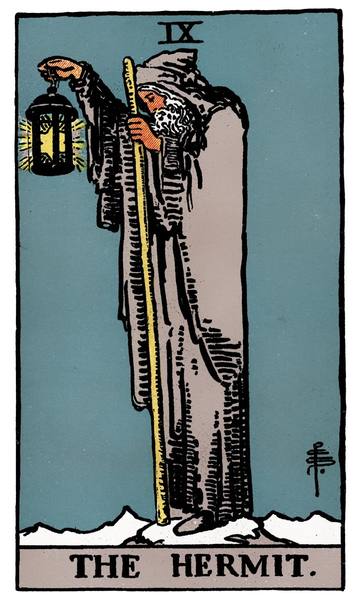
The Hermit Tarot Card Meaning
Keywords
Lantern, staff, grey cloak, snow, one finding, a return time, mountain, small light. Use the words to plan a withdrawal that ends. If you cannot say when you will come back and what you hope to see, you are not looking. You are leaving the room.
The picture
An old man stands on a snowy height in a long grey cloak, the hood up. His beard is white. He looks down, not out at an audience. In one hand he holds a lantern at shoulder height. Inside the lantern a star is lit, a six-pointed shape in the glow, small and contained by glass and metal. In the other hand a plain staff reaches from his grip to the snow. The staff is taller than it needs to be for a stroll. It is a support on bad footing.
The ground is white and uneven. The sky behind him is a flat grey-blue, empty of sun, crowd, or city. No student walks behind him in this picture. The light he carries does not illuminate a valley. It illuminates the next place he might put his foot, and a little of the cloak. The mountain is the peak under him, not a scenic range for someone else to admire. He has gone up. He has not vanished. The cloak is practical. The lantern is practical. The whole figure is one person looking, with a way to walk back down.
Upright
Step back far enough to see it. One lamp, not a crowd.
Step back far enough to see the thing, and bring one finding back. The Hermit is not a mood of being misunderstood. He is a deliberate reduction of noise so a specific question can be answered. Leave the meeting, the thread, the house, for a set number of hours. Take one question up the hill with you. Not seven. What is actually wrong with the plan. What you want from this person. What you keep agreeing to and resenting. Walk until the answer is a sentence, not a weather system. Write it down before you return to the voices that will blur it.
Tell someone when you will speak again, if your absence affects them. A retreat with no return time is a different card. The staff is there because the path is slippery, not because you are founding a solitude. Use the time simply. No new research binge unless the question truly needs one fact. Most weeks the fact is already in your memory, and the crowd was the reason you could not hear it. One lamp, not a festival of insights. If you come down with a slogan and no decision, go back up. The lantern is small on purpose.
The card does not promise a revelation, a calling, or a permanent taste for isolation. It does not promise that the finding will make you look wise when you share it. It may make you look like a person who changed their mind. That is allowed. What it asks is that the looking produce something you can carry. A sentence. A no. A yes. A correction to a story you have been repeating. If the hour produces only the wish to stay away, you have not looked yet. You have only enjoyed the quiet.
Reversed
The retreat has gone on too long. Bring one finding back.
Reversed, the retreat has gone on too long, or it has never honestly started. In the long version, you have made the mountain the job. You are always about to share the finding. Days pass. People adapt to your absence and stop asking. You call this depth. Check the calendar. If you cannot point to a conclusion you reached, the cloak is a hiding place. Pick the day you will come down, and the one sentence you owe the situation. Deliver it even if it feels smaller than the drama of leaving.
In the other version, you refuse every pause and call busyness a moral good. You ask the group what you think before you have been alone with the question for ten minutes. The lantern never gets lit because the room is already bright with other people's screens. Take the hour anyway. Lock the door. One question. The reversal is not cured by a weekend retreat with a schedule full of talks. It is cured by enough silence that your own sentence can form, and by enough return that the sentence meets the life it is about.
A third miss uses "I need space" as a weapon or a fog. You disappear when accountability arrives, then reappear with a spiritual explanation. The staff and the lamp are tools, not a costume that excuses a missed reply. If you need space, name the hour you will be back and the topic you will be ready to discuss. Then be back. A hermit who will not descend is just a man on a ridge. The card includes the path down.
Love
In love, step back far enough to see the bond, then bring one honest finding back. You may need a night alone, a walk, a week of fewer jokes, so you can tell the difference between irritation and a real mismatch. The Hermit is not an order to leave the relationship. It is an order to stop thinking only inside the argument. Tell them you are taking the time, and tell them when you will talk. A silence they did not agree to, with no date, is not clarity. It is a fog you are asking them to live in.
What you bring back should be usable. I want to stay, and I need this term to change. I have been performing fine, and I am not fine. I know now that I do not want the move, the child, the open arrangement, the wedding. One finding. Do not return with a philosophy of relationships and no decision. Do not return with a test. The lantern is for your feet, and then for the conversation. Set it on the table. Let them see what you saw.
The card does not promise that solitude will make you sure, or that they must wait without limit. Give a fair span, not an open winter. If what you see on the mountain is that you have been gone emotionally for months, say that. Leaving can be the finding. It is not the automatic one. Some people draw this card and discover they want the ordinary evening back, and they had been using distance as a way to feel special. Come home and be ordinary on purpose. That is a respectable use of the lamp.
Career
At work, leave the room long enough to see the job, then bring one finding back. The roadmap that no longer matches the user. The meeting that exists because nobody will cancel it. The task you keep assigning to yourself because you do not trust the method. Step out of the chat. Look at the actual object, the numbers, the last three decisions. Write what you see in four lines. Bring those lines to the person who can use them. Do not make the retreat the job. A week of "thinking" with no sentence is avoidance with a mountain view.
If you are the expert everyone taps, the card may be asking you to stop performing answers you have not checked. Go look at the thing again, alone, before you speak. The staff is a reminder that your authority is support, not a throne. If you are junior, the card is permission to form a view before the loudest voice forms it for you. You still bring it back. Insight dumped only into a private note helps no one, including you, once the meeting moves on.
The card does not promise that a solo hour will be respected by a chaotic workplace. Protect it anyway, in a small block you can defend. Early, before the requests start, is better than a dramatic disappearance mid-day. Come back with something concrete. A cut in scope. A risk. A question that replaces three vague ones. Small light, carried into the building. That is the picture used correctly.
In a spread
If the Hermit falls first, you need the pause before the rest of the spread can help. Do not rush to action cards and skip the look. If it falls in the middle, the issue is perception. You are too close, too public, or too tired to see the situation straight. The cards beside it are what you should examine in the quiet, not extra noise to collect. If it falls last, the result is a small light, not a parade. Accept an outcome that is a sentence rather than a transformation. Then walk it back down the hill into the week.
Beside the Wheel of Fortune, remember the order. The lantern does not stop a turn you did not schedule. It shows you where your feet are while the wheel moves. If you only withdraw, you may miss the opening the turn created. If you only spin with events, you never understand what changed. When these two sit together, take the short look first. Name what you see. Then meet the turn with that sentence in hand, instead of with panic or with a pose of detachment. Looking is not the same as refusing to move. The staff is for walking.
Must I leave the relationship because I drew the Hermit?
No. The picture is one cloaked figure on snow, with a lamp and a staff. There is no second person being sent away. The card is about a period of looking, with a way back down. Leaving a relationship can be the conclusion of that look. It is not the assignment written on the card. The misread happens because the figure is alone, so people treat solitude as the advice itself. Solitude is the method. The product is a finding you can say. If you disappear without a return time, you are copying the cloak and ignoring the path. Tell the other person you need a defined pause. Use it to answer one question. Come back and share the answer. If the answer is that you are done, say that cleanly. If the answer is that you want the bond and you have been hiding in busyness or in silence, say that too. The lantern is small. It is enough to see the next true step. It is not an eviction.
Draw itMore tools
- Rising sign calculator
- Moon sign calculator
- Venus sign calculator
- Year lord — the house that rules this birthday year
- Progressed — where the progressed Moon sits now
- Transits — planets moving over your chart today
- Sky — the sky for this date, not a horoscope
- The day — one date, and what it touches
- Birth chart compatibility
- Zodiac compatibility
- Signs — the twelve signs, one page each
- Sun with rising — both signs, when you have a time
- Two moons — two Moon signs, and how they meet
- Cusp — the sign you were born on the edge of
- Tarot — one card, drawn for today
- Yes or no — a three-card tally, not a speech
- Love — a three-card draw about a bond
- Money — a three-card draw about work and cash
- Cross — ten cards, laid out once
- The deck — all seventy-eight cards, upright and reversed