
Rider–Waite
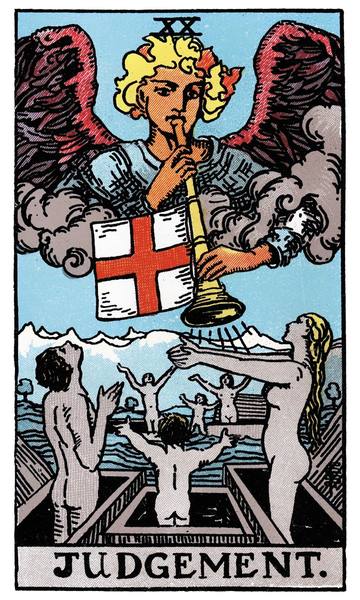
Judgement Tarot Card Meaning
Keywords
Call, trumpet, flag, coffins, rising figures, mountains, water. The words name a reply to something you have already heard. They do not name a stranger's verdict on your worth.
The picture
An angel leans out of cloud at the top of the card, wings wide, golden hair back, a trumpet at the mouth. A white flag with a red cross hangs from the trumpet. Below, the ground is open water with pale mountains behind it. Rectangular coffins float, lids thrown off. A man, a woman, and a child rise from the boxes, bodies bare, arms lifted toward the sound. More figures answer farther off. Nobody is still pretending to be asleep. The trumpet is not a gavel and not a finger pointed at one guilty person. It is a call across the water. The answer, in the picture, is already happening. The boxes are behind the people, not around them.
Upright
A second chance you actually take. Answer the thing you already know.
This week you answer the thing you have already heard. Not a new search. Not a third review to see whether you feel ready. The application you have written and not sent. The apology you have worded and not delivered. The resignation, the archive, the yes to a role you keep 'thinking about' after the thinking ended. Pick the call you would be embarrassed to admit you recognized months ago. Reply in a form that changes the week: sent, said, signed, or formally declined.
The card does not promise forgiveness. It does not promise the people in the other boxes stand up with you. It does not promise a new identity arrives fully formed because you finally moved. Rising is a verb, not a glow. A long message about how much you have reflected is not an answer if Monday looks the same. You can decline the call. Declining, said plainly, is a reply. Silence after you have heard it is the miss, and another week of research is silence with stationery.
Reversed
The call has been heard and not answered. Answer, or close it.
The miss is hearing the call and staying in the box. You schedule another conversation about readiness. You edit the letter for tone until the occasion passes. You tell yourself you will answer when you are a better person, which is a way of never meeting the person who would have to do the thing. The coffin in the picture is open. Staying in an open box is a choice with a sore back.
The other miss is answering a call that is not yours. Someone else's crisis, a parent's unfinished plan, a public mood, a prize you do not want. You rise for it because motion feels like virtue, and your own unsent reply stays in the drawer. Busyness is not the trumpet. Before you stand, ask when you first heard this particular call, and whether it was addressed to you. If it was, answer this week in one concrete way. If it was not, lie back down on purpose and let that noise pass over the water.
Love
A second chance counts only if a specific step is taken. Not a speech about growth. The step might be an apology paired with a changed behavior they can see without taking your word. It might be a clear end so the other person can get up without you standing on the lid. It might be the conversation you have postponed since the last honest night, held once, without a sequel planned as an escape hatch.
The card does not promise they offer you any chance at all. If they have not called, you do not get to demand the box open on your timing. Your call may be the private one: stop hovering, stop the check-in that is really a claim, go live the life you described. If they have called and you are waiting to feel worthy, notice that worthiness has become the coffin. Answer or release them. A third talk about whether the bond 'deserves' another try is not a rising.
Career
The unsent application, the review you owe, the idea you should archive, the role you have been half in for a quarter. Choose one and close the loop. Send it or put it away where it no longer pretends to be pending. A pending item you will not touch is a coffin you visit for the feeling of importance. You do not need another document to understand it.
You are not promised the job, the pardon from a boss, or a chorus of agreement. You are promised nothing, which is why the reply has to be yours. If the call is to leave, leave cleanly: dates, files, a note without a lecture. If the call is to stay and do the avoided part of the job, do that part in public this week. Rising, at a desk, looks ordinary. Ordinary is the point. The angel does not ask for a performance of awakening.
In a spread
In the first position, the call is old. Do not treat the spread as a search for what you want to be. Treat it as a reply to what you already know. In the middle, you are half out of the box and narrating the moment. Narration is not the rise. Ask which action the middle card has replaced. In the last position, the result is a reply, not a new quest. If you end the reading by looking for another deck, another opinion, another sign, you have refused the last card.
Next to The World, the wreath is early if you have not answered. Completion is a later picture. You do not get to wear the closed circle as a mood while the trumpet is still going and your hands are still on the lid. Answer first. Then, and only then, talk about an ending. The pair is strict about order. People reverse it because a finished feeling is nicer than a sent message.
Does Judgement mean someone else is judging me?
The picture is not a courtroom, not a scorecard, and not a boss, parent, or stranger deciding what you are worth. The trumpet is a call you have already heard. The people are getting up. The misread turns the card into social anxiety: what do they think, did I pass, am I exposed. Other people's opinions may be loud in your week. They are not the angel. What you owe the card is a reply to a recognition, not a defense in front of a panel. The recognition might be that a chapter is over, that an apology is due, that a piece of work is yours to claim or to drop. If you spend the week gathering reviews of yourself, you are still in the box, collecting echoes. Stand up and do the one thing the call named. Let the mountains stay in the background. They are not a jury. They are the far edge of the scene, and they do not vote.
Draw itMore tools
- Rising sign calculator
- Moon sign calculator
- Venus sign calculator
- Year lord — the house that rules this birthday year
- Progressed — where the progressed Moon sits now
- Transits — planets moving over your chart today
- Sky — the sky for this date, not a horoscope
- The day — one date, and what it touches
- Birth chart compatibility
- Zodiac compatibility
- Signs — the twelve signs, one page each
- Sun with rising — both signs, when you have a time
- Two moons — two Moon signs, and how they meet
- Cusp — the sign you were born on the edge of
- Tarot — one card, drawn for today
- Yes or no — a three-card tally, not a speech
- Love — a three-card draw about a bond
- Money — a three-card draw about work and cash
- Cross — ten cards, laid out once
- The deck — all seventy-eight cards, upright and reversed