
Rider–Waite
The Hierophant Tarot Card Meaning
Keywords
Form, teacher, vow, keys, students, contract, method, rite, a practice you can repeat. Use the words to find a structure that already exists and still does the work. They are not an order to join anything. A private ritual invented to avoid a plain promise is not this card.
The picture
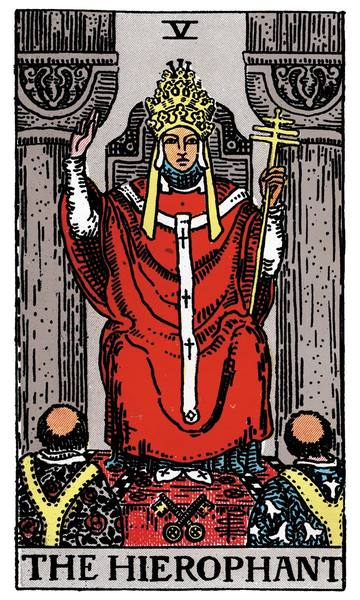
A teacher sits between two grey pillars, raised above the floor of a formal room. He wears a triple crown, three tiers stacked, and he holds a scepter marked with a triple cross. His right hand is lifted in a blessing, two fingers extended. The robe is heavy, layered, the kind of garment that signals an office rather than a mood. At his feet lie two keys, crossed, one gold in tone and one darker. They are large enough to see. They are not in his hands. They rest where the students can see what locks and opens the place.
Two acolytes kneel in front of him, heads inclined, robes marked with flowers. One pattern reads as roses, the other as lilies. They are not identical, and they are not arguing. They are inside a lesson that already has a shape. The shaved patch on each head, the matched posture, the pillars, the crown. All of it says school, church, guild, or court. The picture is a lesson with a form. It is not a private flash of insight on a hillside. Nobody in the scene is inventing the rite as they go.
Upright
Use the form that already exists. A teacher, a contract, a practice.
Name the form that already exists for the thing you are trying to do. A teacher who has taught this before. A contract with dates and names. A license, a syllabus, a vow, a meeting that happens on Thursday whether you feel original or not. The Hierophant is the method you did not have to invent this morning. Use it if it still does the work. Pride in starting from nothing is often fear of being a student. Sit down. Learn the form. Then you will know what, if anything, needs to change.
This week, enter one existing structure on purpose. Book the class. Sign the plain agreement. Ask the person who has done the job for the sequence, and follow it once before you improve it. If you share a household or a team, pick a practice you can both show up for without a speech. A weekly account of the money. A review of the work on Friday. A promise with a verb in it. The keys in the picture are crossed and visible. Access is a shared fact, not a fog you administer.
The card does not promise that tradition is wise, or that the person in the crown deserves it. It does not promise that a ceremony will create a feeling you do not have. A form can be empty and still look correct. Test the form by what it produces in ordinary weeks. If the class teaches, stay. If the contract protects the thing you care about, sign. If the rite only flatters the person at the front, you have learned something. You are allowed to leave a school. You are not allowed to pretend you outgrew the lesson when you never took it.
Reversed
The form is empty. Keep the practice only if it still does the work.
Reversed, the miss is loyalty to a dead method, or a refusal of every method in the name of being real. In the first version, you keep the meeting, the vow, the syllabus, or the approval long after it has stopped doing the work. You call that fidelity. The students kneel because the picture says kneel, and nobody checks whether anyone is learning. Drop the piece of the form that is only costume. Keep the piece that still teaches, protects, or coordinates. A crown is not a reason.
In the second version, you will not use any shared form because it feels borrowed. You invent a private language for two people, or a process only you understand, and you call that honesty. Often it is a way to avoid a standard that would expose you. A contract would make the date real. A teacher would see the gap in your skill. A known rite would force a public yes or no. If that is the resistance, name it. Then use the smallest ordinary form that closes the escape hatch.
A third miss is performance of the role. You take the blessing hand and the triple cross and you deliver advice you do not follow. You become the person friends ask, and you never sit in the student seat yourself. The card reversed asks you to kneel for one hour in a discipline that is not your show. Take the class. Keep the appointment. Let someone else hold the keys for a week. Authority that never returns to practice becomes a costume with a nice hat.
Love
In love, use a form that already exists and that you can keep. A clear status. A promise with a boundary. A practice you both show up for, such as Sunday dinner, a money talk on the first of the month, or a rule about how you fight. The Hierophant is not a mood of sacredness. It is the repeatable structure that lets two people trust the week. If you need a new private religion every time the feeling dips, you are hiding a decision inside novelty.
Marriage is one form. It is not the only one this card can mean, and it is not required because you drew it. Some bonds need a public promise. Some need a plainer agreement about rent, children, or fidelity, without a wedding. Some need to end, and no rite will supply the missing yes. Ask which form matches the bond you actually have. Then offer that form, or accept it, in words a clerk could file. If you cannot say the terms without incense, the terms are not ready.
The card does not promise that a ceremony will repair contempt, secrecy, or unequal work. A vow taken to quiet a family, or to stop a fight, is the reversal in formal clothes. Do not kneel in order to avoid the sentence. If you want the form, want the practice that comes the next morning. If you do not want the practice, do not borrow the crown. A relationship can be serious without being married. It cannot be serious with no form at all, unless you both truly want a bond that resets every day. Most people who say that want the freedom and also want the other person to stay. That is not a form. That is a wish.
Career
At work the existing form is the point. A mentor, a contract, a checklist, a license, a code review, a class with homework. Use the one that would make your current gap obvious, and stay in it long enough to be corrected. Skipping the method because you are talented is how talented people stay uneven. The acolytes are not humiliated by kneeling. They are in the seat where the lesson can land. Take that seat once this week without managing how you look in it.
If you teach, manage, or advise, check that the form still serves the student and not only your status. A meeting with no decision, a review with no standard, a brand of leadership with no transferable skill. Those are empty crowns. Restore a practice someone else could run without your personality. Write the steps. Name the pass and the fail. Hand over a key. The card is a school, not a court where everyone waits to hear how you feel about the work.
The card does not promise a certificate will make you competent, or that obedience to a bad institution is a virtue. If the method is rotten, say so with a specific flaw, not with a speech about how systems crush originality. Then either repair the one step you can repair, or leave for a form that still teaches. Drifting without any standard is not liberation. It is how the work becomes impossible to judge, which is comfortable right up until it fails in public.
In a spread
If the Hierophant falls first, you are already inside someone else's rules. Read the rest of the spread as how to use those rules, or where they have gone hollow. Do not spend the reading inventing a rival system before you understand the one you are in. If the card falls in the middle, the question is which form fits the problem. Look to the neighboring cards for the material, and answer with a practice, a teacher, or a contract, not with a new identity. If the card falls last, you are being asked to teach or to sign. The outcome is a commitment to a form. It is not a private revelation you get to keep unnamed.
Beside the Lovers, keep the difference sharp. The Lovers is the choice between two goods. The Hierophant is the form that makes a choice livable after the blush of deciding. A vow that skips the choice is empty. You signed because the script was in the room. A choice that refuses every form never becomes a week you can repeat. You picked, and then you declined every practice that would show whether you meant it. If both cards are present, choose first, in daylight. Then pick the smallest existing form that will hold the choice for a month. Do not build a chapel to avoid either step.
Must we get married because I drew the Hierophant?
No. The card shows a teacher, two students, a triple crown, and a pair of crossed keys. It is a picture of form. Marriage is one form a culture uses for a bond. It is not printed as a requirement on this card, and a reading cannot supply consent the two of you do not have. Ask a plainer question. Do we need a structure we did not invent, so the bond can be seen and repeated. Sometimes the honest answer is a wedding. Sometimes it is a lease, a will, a fidelity agreement, or a shared calendar. Sometimes the honest answer is that you do not want the practice that follows any of those, and you should say so. The misread is treating the crown as a push from outside the relationship. The keys are on the floor between the students. The form you pick has to be one you can both reach.
Draw itMore tools
- Rising sign calculator
- Moon sign calculator
- Venus sign calculator
- Year lord — the house that rules this birthday year
- Progressed — where the progressed Moon sits now
- Transits — planets moving over your chart today
- Sky — the sky for this date, not a horoscope
- The day — one date, and what it touches
- Birth chart compatibility
- Zodiac compatibility
- Signs — the twelve signs, one page each
- Sun with rising — both signs, when you have a time
- Two moons — two Moon signs, and how they meet
- Cusp — the sign you were born on the edge of
- Tarot — one card, drawn for today
- Yes or no — a three-card tally, not a speech
- Love — a three-card draw about a bond
- Money — a three-card draw about work and cash
- Cross — ten cards, laid out once
- The deck — all seventy-eight cards, upright and reversed