
Rider–Waite
The Emperor Tarot Card Meaning
Keywords
Throne, rule, border, deadline, budget, owner, ram, stone, a limit you keep. Use the words to put one edge on a thing that has none. They are not a compliment and not an insult. A rule you will not enforce is not a rule. It is a decoration.
The picture
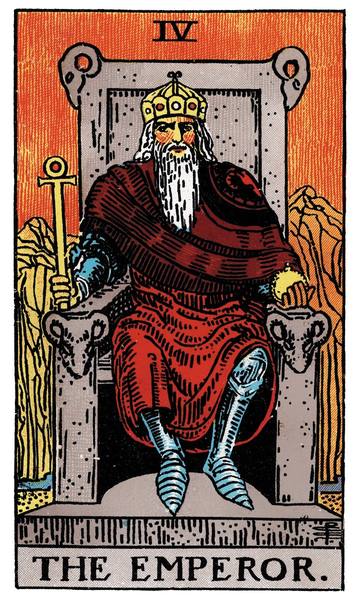
A bearded man sits on a stone throne set outdoors against bare mountains. The throne is a block, hard-edged, and the arms are carved with ram heads. He wears armor under a red robe, the metal visible at the arms and neck, so the cloth is not the whole story. In one hand he holds a scepter shaped with an ankh. In the other, a globe. His crown is plain and heavy. One foot is forward. The mountains behind him are orange and empty of trees. Nothing in the landscape looks soft or accidental.
The rams mark the throne four times, a repeated animal, not a single ornament. The stone does not yield. The armor says the body is guarded. The scepter is a sign of rule held still, not swung. The barren peaks make the point that this card is not a garden. Order here is cut against rock. You can see the border of the seat. You can see what is armor and what is robe. The picture is a structure with an occupant who is willing to sit in it for a long time.
Upright
Put a rule on it. A deadline, a budget, a boundary.
This week, put one limit on the thing that has been all wish. A deadline with a clock time. A budget with a number. A boundary about how you are spoken to, written down and then kept. An owner, meaning a person who can say yes or no, including you. The Emperor is a border. Without the border, the work, the bond, or the day spreads until nothing finishes. Choose the limit that would change your behavior on Wednesday, not the limit that sounds stern in a notebook.
Say the rule once, in plain words, to the people it affects. Then keep it. A rule you explain five times and never apply teaches everyone that the throne is furniture. If the limit is for yourself, write the consequence you will actually accept. No phone in the first hour. No new scope after Tuesday. No meeting without an agenda and an end time. The armor in the picture is the part of you that does not negotiate with every passing mood. You do not need to be cold to wear it. You need to be consistent.
The card does not promise that order will make you loved, or that a tight structure is always the right one. It does not promise authority you have not been given. It says that a wish with no edge does not ship, and a bond with no terms turns into guesswork. If you already have too many rules, the upright card is not an invitation to add another. It is an invitation to enforce the one that matters and delete the ones you only use to feel in charge.
Reversed
The rule is too tight, or there is no rule at all. Choose which one is true.
Reversed, decide which miss is live, because they are opposites. Either the rule is too tight, or there is no rule at all. In the tight version, you control tone, time, method, and outcome past the point where other people can think. You call it standards. They experience a stone seat they are not allowed to leave. Look for the rule that exists to soothe your fear rather than to finish the work. Loosen that one. Keep the rule that protects a real boundary, such as pay, safety, or a promise you made.
In the empty version, you refuse structure and then complain that nothing lands. You will not set a date because dates feel harsh. You will not name an owner because ownership feels like ego. The mountains stay barren because nobody builds a path. Pick the smaller miss and correct it. Do not correct both at once with a speech about balance. If you are rigid, remove one control today and leave the rest for later. If you are vague, add one control today and stop there.
A third miss sits between them. You announce rules in anger and drop them when the room gets uncomfortable. That is not strength and it is not flexibility. It is a throne you only sit on when you are losing an argument. The reversal asks for a rule you can keep on a calm day. Write it when you are not furious. Apply it when you are not trying to win a scene. If you cannot keep it calm, it was never a border. It was a weapon.
Love
In love a boundary is the kindness. Name one rule about time, money, or tone. You will not read their messages for an hour after you wake. You will not fund a plan you have not agreed to. You will leave the conversation if the insults start, and you will not deliver a parting lecture. Say it once. Then keep it without a trial period of warnings you do not mean. The Emperor is not warmth, and he is not cruelty by himself. He is the edge that lets warmth have a shape.
Control dressed up as care is the miss. Tracking, correcting their friends, managing their clothes, their body, their ambition. If the rule mostly limits them and leaves you unchecked, it is not a boundary. It is a small throne you built for one. Flip the test. What limit are you accepting on yourself in the same bond? If the answer is none, rewrite the rule until it binds you too, or drop it.
The card does not promise a peaceful household because you have become strict. It does not ask you to play the parent unless you are actually parenting a child, in which case the rules should be few, clear, and survivable. With another adult, terms are agreements, not decrees. If they will not agree to a term you need in order to stay, that is information. You may leave, or you may accept the bond without that term. Do not pretend a decree is the same thing as a mutual rule.
Career
At work, put a deadline, a budget, or a named owner on the job that has been floating. A wish with no edge does not ship. An owner who never looks at the work is a title, not a rule. If you are the owner, decide the scope in writing and refuse the next addition until the current scope is done. If you are not the owner, ask who is, in a sentence that expects an answer. Floating work makes everyone tired and makes no one accountable.
Use the armor for the hard no, not for everyday contempt. You can reject a date that breaks the product without mocking the person who asked. You can hold a standard for the draft without rewriting their voice to prove the throne is yours. The mountains in the picture are bare so you remember that harshness is easy. The harder task is a rule people can follow without flinching every hour.
The card does not promise a promotion to the person who sounds most like a boss. It promises that an unordered week stays unordered no matter how talented the team is. If you already run a tight system and the work is dying inside it, loosen one constraint that is fear, not function. The Emperor reversed and upright meet at the same practical test. Does this limit help the thing get finished by a real person, or does it only help you feel impregnable?
In a spread
If the Emperor falls first, the structure is already available. You may be resisting a rule that would help. Read the later cards as what belongs inside the border, not as reasons to avoid building it. If he falls in the middle, the reading is about authority, time, or money, and you should answer with a limit rather than with more feeling. If he falls last, you still have to set the edge. The outcome does not arrive pre-fenced. You write the fence and then live with it for more than a day.
Beside the Hierophant, do not confuse a personal rule with an inherited one. The Emperor is the border you set and keep. The Hierophant is the school, the contract, the rite, the method that already existed before you. If both appear, ask which one you are hiding behind. You may be enforcing a tradition you have not examined, or you may be inventing a private law to avoid a standard your peers already share. Use the tradition if it still does the work. Use your own rule where the tradition is silent or rotten. Sitting on a stone throne inside a dead school teaches nothing but stiffness.
Is the Emperor always a man?
No. The printed picture shows a bearded figure in armor, because that is how this deck drew rule and stone in 1909. The instruction is not "find a man" and it is not "behave like a stereotype." Anyone can set a deadline, a budget, or a boundary. Anyone can refuse to. The rams, the throne, and the mountains are about hardness of edge, not about a required body. People misread the card as a husband, a boss, a father, or the state, arriving from outside to sort the week. Sometimes a person in authority is part of the story. Often the throne is empty because you will not sit in it. Read the card as a job. Put one limit in place and keep it. If a man in your life is acting like a stone seat you cannot leave, that is a situation to judge on its facts, not a destiny the picture assigned you. The armor is optional. The rule is not.
Draw itMore tools
- Rising sign calculator
- Moon sign calculator
- Venus sign calculator
- Year lord — the house that rules this birthday year
- Progressed — where the progressed Moon sits now
- Transits — planets moving over your chart today
- Sky — the sky for this date, not a horoscope
- The day — one date, and what it touches
- Birth chart compatibility
- Zodiac compatibility
- Signs — the twelve signs, one page each
- Sun with rising — both signs, when you have a time
- Two moons — two Moon signs, and how they meet
- Cusp — the sign you were born on the edge of
- Tarot — one card, drawn for today
- Yes or no — a three-card tally, not a speech
- Love — a three-card draw about a bond
- Money — a three-card draw about work and cash
- Cross — ten cards, laid out once
- The deck — all seventy-eight cards, upright and reversed