
Rider–Waite
Death Tarot Card Meaning
Keywords
Ending, armored skeleton, white rose, black flag, fallen king, child, bishop, rising sun, river. The words name a close that is already underway. They do not name a mood of gloom, and they do not name a person who is doomed.
The picture
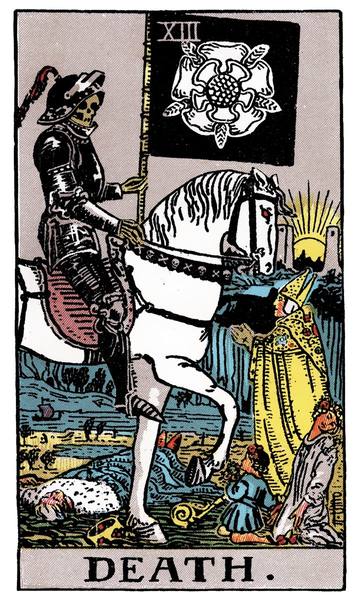
A skeleton in black armor rides a white horse at a walking pace. The skull is bare under the raised visor. In one hand the rider holds a black flag, and on the flag is a single white rose. On the ground a king has fallen. His crown lies beside him in the grass, separate from his head. A child kneels among the figures and looks up, not running. A bishop in a mitre stands with hands raised, placed between the fallen king and a young woman whose head is bowed, pale gown gathered as she kneels. Behind them a river crosses the card, with a small boat on the water. Farther back, two towers stand, and a sun is coming up in the gap between them. The horse keeps moving. The flag does not droop into a threat. The morning is already in the picture, behind the bodies and the kneeling, not instead of them.
Upright
Something is over. Clear it so the next thing can start.
This week you close one thing that has already ended. Pick the thing you are still feeding out of habit. A role you left. A chat you keep alive so you do not feel the stop. A draft of a life that needed a yes you did not get. Make the close visible enough that you cannot pretend it is still current. Send the note. Cancel the plan in writing. Take your name off the list. Clear the hook by the door. Tell the person who would otherwise keep inviting the old version of you.
The card does not promise a beautiful replacement by Friday. It does not promise grief will be tidy, short, or instructive. It does not ask you to feel ready. Readiness is not the gate. The gate is the stop. The sun between the towers is a fact about sequence. Morning comes after the end in the picture. It is not a prize you earn by suffering correctly, and it is not a date you can demand. Stop feeding the finished thing. Let the next thing, if there is one, arrive without a costume made of the old name.
Reversed
You are keeping a finished thing alive. Let the ending be an ending.
The miss is a corpse you keep on the schedule. You say the project is resting. You say the bond is on a break when you mean it is done. You leave the old title in your signature. You check the door of a job that ended last season. The cost is not dramatic. It is the hour you spend maintaining a fiction, and the way new work cannot sit down because the chair is still saved.
The other miss is a theatrical cut. You end something that is still alive because you want the feeling of a clean edge. You quit the useful class, burn the draft that needed one more afternoon, block a friend over a repairable slight, and call the mess fate. Death in this deck is for what has already died, not for what you are bored of. Before you swing, ask what still functions. If it functions, you are looking at a different card. If it does not, stop narrating and close it in the open, without a speech about transformation.
Love
Some version of a bond is over. Name which version, in words that cannot be mistaken for a pause. The exclusive agreement. The plan to move. The hope that they will stop a specific habit you have already asked them to stop. The dating story you are telling friends that does not match the calendar. If the whole bond is over, say so, and stop the small tendrils: the midnight check, the joke that reopens the door, the practical question that is really a visit.
The card is not a threat to wave at them, and it is not proof that a person must leave. Sometimes the dead piece is the fight, the old rule, the way you monitor each other, and the people stay. You only get that reading if you can point at the piece. A vague sense that something has to die is how people scare a living relationship. Be plain. Do not call it a break if you mean done. Do not call it done if you mean you want a different dose of the same thing. That second request belongs with a different picture.
Career
A phase at work has ended, whether the announcement has caught up or not. The client who will not renew. The feature nobody uses. The role you are still performing after the reorg moved the work to someone else. Close it where other people can see the close. Archive the board. Send the handoff. Take the recurring meeting off the calendar. A quiet hope that the old project returns is how it stays half-dead and keeps eating Tuesdays.
You do not get a guarantee that the next assignment will be better, or that closing the old one will make you look brave. You might look late. Close it anyway. If you are the person who needs to hear that your piece is over, do not make your team hint for another month. Ask. If the answer is that the piece is still wanted, then this card was your fear, not the work. If the answer is that it is finished, stop polishing the coffin.
In a spread
In the first position, the old story is the subject, and it is already finished. Do not spend the reading asking how to revive it. In the middle, the change is underway and still unnamed. Your job in that spot is to give the ending its real name so the later cards have something solid to follow. In the last position, nothing new in the spread can start cleanly until the close is public enough. A private ending that you contradict in public is not an ending.
Next to Temperance, do not try to blend the dead thing into the next pour. Measure what remains after the close, not before it. A little of the old habit mixed into the new week is how the skeleton keeps the horse. Finish first. Then use a smaller dose of whatever is actually still alive. If you temper too soon, you are watering a stump and calling it care.
Does the Death card mean someone is going to die?
This is not a medical prediction, not a threat, and not a hint about a body. If someone is ill, call a doctor. Do not call a deck. The picture uses a skeleton because endings are blunt, not because the reading is a morgue. In an ordinary week the dead thing is a role, a plan, a status, a habit, or a story you keep feeding after it has stopped breathing on its own. People fear the card so they can avoid a smaller truth. It is easier to shudder at a horseman than to take your name off a group chat. The white rose on the black flag is not a promise of rebirth on your schedule. It marks that life continues in a form that is not the fallen king's form. The child in the picture is not spared because of innocence points. The child is simply not the one on the ground. Ask what is on the ground in your week. Then stop asking the card to scare you away from naming it.
Draw itMore tools
- Rising sign calculator
- Moon sign calculator
- Venus sign calculator
- Year lord — the house that rules this birthday year
- Progressed — where the progressed Moon sits now
- Transits — planets moving over your chart today
- Sky — the sky for this date, not a horoscope
- The day — one date, and what it touches
- Birth chart compatibility
- Zodiac compatibility
- Signs — the twelve signs, one page each
- Sun with rising — both signs, when you have a time
- Two moons — two Moon signs, and how they meet
- Cusp — the sign you were born on the edge of
- Tarot — one card, drawn for today
- Yes or no — a three-card tally, not a speech
- Love — a three-card draw about a bond
- Money — a three-card draw about work and cash
- Cross — ten cards, laid out once
- The deck — all seventy-eight cards, upright and reversed