
Rider–Waite
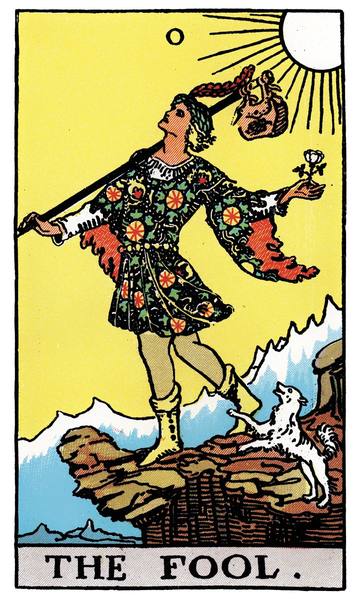
The Fool Tarot Card Meaning
Keywords
Begin, cliff, white rose, bindle, first step, open risk, light pack, unplanned move. Treat the list as checks for the week, not as a personality. A start with no step you can name is only a mood. A step that throws away the rent, the bond, and the job in one afternoon has left this picture.
The picture
A young traveler in a patterned tunic stands at the edge of a cliff. The cloth is covered with circles and flowering shapes, bright against a pale sky. One foot is set forward, as if the next pace will leave the ground. He does not look down at the drop. His face is turned up toward the sun, which sits in the corner with straight rays. Far behind him the mountains are cold and small. The cliff is not a soft hill painted in fog. It is a sharp edge, and the air under it is empty.
In one hand he carries a white rose, stem long, bloom open, held with some care. Over the other shoulder a staff rests, and from it hangs a small bindle, a cloth pack with almost nothing in it. A white dog rears at his heel, mouth open, body in motion. The dog is the only figure attending to the danger. The traveler keeps the rose. He does not drop the pack to prove he is free. Nothing in the picture shows a bridge, a rope, or a crowd waiting below to catch him.
Upright
A start with the map still blank. Take the step, not the whole plan.
This week, name one step you can undo on Friday if it goes wrong. Send the message you have rewritten nine times. Book the room. Put the draft where another person can see it. Walk into the office hour, the first meeting, the class that starts on Tuesday. The Fool is a start with the map still blank, which means you stop waiting for the whole route to appear before your foot moves. Pick a step small enough that a miss teaches you, and large enough that you cannot pretend you stayed home.
Do the step in daylight, with one witness or one written trace. A private fantasy of leaving is not a beginning. Tell one person the single thing you will do, and the day you will do it. Then do that thing and stop. Do not add a second leap because the first one felt clean. The card is one pace toward the edge, not a tour of every cliff you can find.
What this picture does not hand you is a rescued landing. It does not promise that the people who liked the old plan will approve. It does not promise money, a welcome, or a story you will want to tell at dinner next year. The sun is shining and the dog is alarmed. Both are in the card. Take the step. Keep the rose. Leave the ten-year speech on the table until you know what the ground on the other side actually is.
Reversed
The step is late, or it is reckless. Look once before you jump.
Reversed, the Fool is usually one of two misses, and they do not look like each other. The first is delay dressed up as care. You have stood at the same edge for months. You call it research. You collect one more story about someone who jumped and got hurt. The pack is still on your shoulder. The rose is wilting in a jar by the door. No step has been taken, and the caution has become the whole week.
The second miss is a performance of freedom. You quit, announce, discard, or confess in a rush so you can feel like the figure in the tunic. You do not look at the drop. You ignore the dog. You throw the rose because keeping it seems timid. That is not courage. It is a wish to be seen mid-air. Before you pick a remedy, decide which miss is yours. If you have not moved, move once, in a way you can survive. If you are already mid-leap with your eyes shut, open them and grab the nearest solid fact. A rent figure. A reply you owe. A date. A cost.
Do not read the reversal as a ban on starting. It is a ban on lying about the start. A late beginning is still a beginning if you take it. A reckless one becomes honest when you name the price out loud and choose again. This week, write the step and the risk on the same line. If you cannot write the risk, you are performing. If you can write the risk and still refuse every version of the step, you are stalling.
Love
In love the Fool is a beginning that has not been given a name. You met someone and you are already writing the third year in your head. Or you have been with someone for years and you want the first week back, which is not the same thing as wanting them. This week, make one invitation that can be declined. A walk with a time on it. A clear question. A plan for Saturday that does not require them to change their life by Friday. Ask once. Then leave room for a no without a speech about how rare the chance is.
The card does not promise that the other person steps off the cliff with you. It does not promise that a new face repairs an old bond you still refuse to discuss. If you are already partnered, the honest start is a sentence you have not said, not a secret second life that makes you feel young. If you are single, one real meeting beats a week of imagining the meeting. Stay kind while you take the risk. Do not throw ordinary manners away to prove you are spontaneous. A white rose carried over a cliff is care plus movement. Either one without the other is a different card.
Career
At work this is a first piece with the map still blank. Ship something small enough to finish by Thursday. A page. A prototype. A request for twenty minutes. A test with one user who can answer you in a sentence. Do not wait until the whole plan feels safe. Do not resign to prove you are the traveler. The bindle is small because the trip is a start, not because having no money is a moral good. If the work needs a tool you do not have, borrow one tool. Do not build a new identity before you use it.
The card will not pay your rent in exchange for a mood of freedom. A resignation is a Fool step only after smaller steps have shown you a place to stand next month. Most weeks those smaller steps are still undone, and the fantasy of quitting is how you avoid them. Put the small piece where a colleague can respond. If nobody can answer it, it is still a private daydream, and the dog in the picture is right to bark. Count the hours the step will take. If you cannot count them, you do not have a step. You have a poster.
In a spread
If the Fool falls first, the old frame is already behind you, even if your calendar still looks the same. Read the later cards as the ground you have not checked. Do not spend the whole spread arguing with the fact that a start is on the table. If it falls in the middle, the question itself is whether you will take the unnamed step. The cards on either side are the cliff and the pack. Look at them before you move. If it falls last, the outcome is a beginning, not a conclusion you can frame. You do not get a finished life at the end of this reading. You get a pace, and a week in which to use it.
Beside the Magician, the step needs one tool that is already on the table. The Magician keeps you from jumping with empty hands. The Fool keeps you from polishing those tools until the week is gone. Use one tool on one step. If you draw both and then open a new notebook to plan a third project, you have dodged the pair. The neighboring card is not permission to collect more beginnings. It is a limit. Hands, table, one pace.
Should I quit my job because I drew the Fool?
No. The card is a first step with the map still blank, not a resignation letter. Quitting can belong to this picture only when the smaller steps are already taken and the job itself is the cliff you keep refusing to see. Most weeks the honest action is a portfolio piece, a conversation with a date on it, a class, or a trial of the work you claim you want. The traveler still has the rose and the pack. He has not thrown them into the gorge to prove a point. If you quit so the card will feel true, you are using the picture as a dare. Look at the drop. Write what the next sixty days cost if the new plan is slow. Then take the step you can still live with on Thursday. A notice letter is a last resort in this reading, not the first romantic gesture. The dog is there to make you look down once. It is not there to cancel the walk.
Draw itMore tools
- Rising sign calculator
- Moon sign calculator
- Venus sign calculator
- Year lord — the house that rules this birthday year
- Progressed — where the progressed Moon sits now
- Transits — planets moving over your chart today
- Sky — the sky for this date, not a horoscope
- The day — one date, and what it touches
- Birth chart compatibility
- Zodiac compatibility
- Signs — the twelve signs, one page each
- Sun with rising — both signs, when you have a time
- Two moons — two Moon signs, and how they meet
- Cusp — the sign you were born on the edge of
- Tarot — one card, drawn for today
- Yes or no — a three-card tally, not a speech
- Love — a three-card draw about a bond
- Money — a three-card draw about work and cash
- Cross — ten cards, laid out once
- The deck — all seventy-eight cards, upright and reversed